Tuesday, 11 November 2014

Chawa’s Immigration Certificate

In November 1935 my grandfather’s sister Chawa Florkiewicz applied for permission to immigrate from Poland to Palestine, then under British control. Her application was approved by the British Authorities in Palestine in April 1936. This is the Certificate of approval. It was returned to Lajzer Finkelstein, her brother, who lived in Tel Aviv and was acting on her behalf. She is instructed to take the Certificate, together with her passport, to the British Consulate in Warsaw by 5 August, and that it would only be valid for entry to Palestine until 15 August.

This implies that Lajzer needed to send it on to her in Poland fairly quickly, so that she could have time to make the necessary arrangements. However, it appears he didn’t send it, as it was amongst a collection of his papers found by his daughter Bracha just last year. Chawa did not make the journey, but not because Lajzer had not sent on the Certificate; in July she sent him a letter explaining why - please see the earlier post ‘Dear Brother’ for details.

Chawa's children
The application includes her two younger children, Szejwa, 16, and Jankel Josek, 14. The two older daughters, Marjem, 20, and Laja, 18, are not on the Certificate; they may have been studying or working, or had other reasons not to leave. We know very little about them, apart from what we can glean from documents like this. We know Laja was not married at that time; we know nothing at all about Marjem.

An age-related mystery
Also on the application is Chawa’s mother Gitla, my great-grandmother. And here we have another age-related mystery. Gitla is shown as 65 years old, which puts her year of birth as 1871. However we have a copy of her birth record: she was registered in 1861. She married in 1888, and according to her marriage record, she was 26, which also gives a birth year of 1861/2. The usual rule of thumb is to give more credence to earlier records than to later ones, and I think a dated birth record is pretty decisive. So Gitla was really 75, not 65 as shown here.

Why?
I presume Lajzer was the informant for this document for the British Immigration Office in Palestine. Why does he make his mother appear 10 years younger than she really is? Did the British authorities have an upper age limit for immigration? There are all sorts of possibilities, all sorts of reasons why people sometimes change their own details or those of other family members. Some of these 'amendments' can be identified in my own family - see for example the discussion of Laja's date of birth at the end of the post on the family's Certificate of Residence. However, my preference in this case is for ignorance - my guess is that Lajzer genuinely did not know how old his mother was, so he put something that appeared ‘old’ enough for her to have a 44 year-old daughter.


Sunday, 9 November 2014

Chawa and her family

This is a Certificate of Residence obtained in Poland in 1935 by Chawa, a sister of my grandfather Lajb Frankenstein. She needed the documentation in order to apply for a passport; she was hoping to follow another brother, Lajzer, in emigrating to Palestine. A year later she wrote to Lajzer to say they weren't able to come at that time - for a discussion of that letter, see my earlier post 'Dear Brother'. Chawa never left Poland, but somehow the Certificate ended up amongst a batch of Lajzer's papers that his daughter Bracha came across a year or so ago. Chawa's grand-daughter Ewa - named for her - brought me a copy when she visited us from Israel earlier this year.

Ewa was keen - to put it mildly - to find out anything we could about her grandmother, and about her own mother Laja, and this document is a mine of information. As is often the case, it raises as many questions as it answers. Here's a brief outline of what we found out from the form.


In the document, issued in the town of Gombin (Gabin), Chawa is named as Chawa Florkiewicz, née Frenkensztejn. She is a widow. This in itself was new information for Ewa, as it implies that her grandfather Elias had died by 1935; she had known nothing of him apart from his name.

My great-grandparents
Chawa's parents are shown as Jankiel Josek and Gitla née Kon. This was the first documentary confirmation we had found of the names of our great-grandparents, and an indication of a family name - Kon - we had not been aware of.


Chawa's birth-date
Chawa is shown as born on 1 January 1891. I am always somewhat suspicious of birth dates from this period that appear as '1 January' or '31 December' - or other first and last dates - as births were sometimes not registered until weeks or months - sometimes years - afterwards. The parents may not have noted the exact day of the birth at the time, and just declared a convenient date for the registration. We don't have any other documentation for her at the moment, so we'll have to accept it until we do.

Juliszew - our ancestral home?
Chawa was born in Juliszew, a place Ewa and I had not heard of. We eventually located it on the map - a small village about 12km to the East of the town of Gombin, which is where we thought they all came from. We were so excited to have discovered what we took to be the family's ancestral home! However, when I mentioned this later to Bracha, and our American cousins, they all said, "Ah yes, Yoolashov, my Dad/Grandad/whoever mentioned that place". Nevertheless, this is our first documentary evidence.

Tylna 4
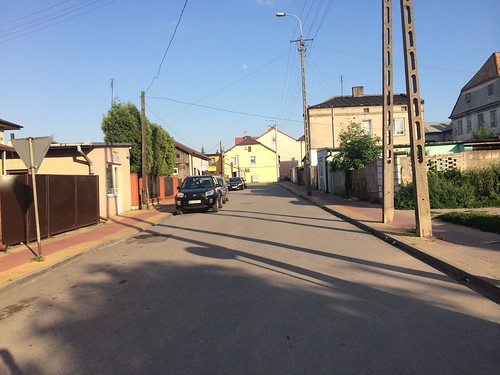
Other entries on the form show Chawa as a 'worker', Jewish, and of Polish nationality. She lives at 4 Tylna Street, which is the return address she put on the envelope containing the letter to her brother. She has lived in Gombin since 1915; before that, she lived in Juliszew.


Tylna Street now. The street is quite short, but there doesn't seem to be a number 4, and we couldn't work out where it would have stood.

The household
The lower part of the document lists the members of the household. Chawa is living with 4 children, which corresponds with what Ewa had heard from her mother. Her mother Gitla does not appear to be living with her, although she was with her a year later (see the letter to Lajzer). The children were all born in Gombin: Marjem born 1915, Laja (Ewa's mother) 1917, Szejva 1919, and the only boy, Jakub Josek, 1921. We noted that Jakub Josek appeared to be named after Chawa's father, Jankiel Josek - Jankiel is a diminutive form of Jakub. The tradition among Ashkenazi Jews was to name children after recently deceased close relatives, and not after those still living, so this suggests that Jankiel Josek had died by 1921.

What we have learned
We can conclude from the form that Chawa was almost certainly living with her parents in Juliszew until she married in 1915, at the age of 24. She and her husband then moved to Gombin, and raised their family there. Her husband died at some point between 1921 and 1935. Her father had also died, before 1921, leaving her mother Gitla on her own, though we think that Chawa's sister Chaia was probably living with her for some of that time. We can surmise from the letter to Lajzer, written a year later, that Gitla fell ill around 1935, when she would have been in her mid-70s, and came to live with Chawa.

Laja's birth-date
The big surprise to us was Laja's date of birth. Ewa had always understood from her mother that she had been born in 1921. This document puts her 4 years earlier. Another date puzzle!
Laja Florkiewicz, in the centre of the group of members of Hashomer Hatzair, a socialist-zionist youth group, 1934

Then I came across this photo, in the Gombin section of Ada Holcman's web site Zchor (Remember!). The young woman in the middle is named as Lea Florkewicz, and Ewa confirms that it is indeed her mother. The young man to her left is Meir Holcman, Ada Holcman's father. The year is 1934. What do you think? Is Lea 13 in this photo, or 17? Was she born in 1921, or in 1917?

The question is, why did she later - after the War - claim a birth date of 1921? On my trip to Poland in June I came across a couple of documents that take Laja's story a little further; I'll discuss them in a later post.

Laja was one of the few young people in this photo who did not perish in the Holocaust. She was the only member of her family to survive.

Monday, 29 September 2014

Dear Brother


In July 1936, my grandfather's sister Chawa wrote from her home in Gombin, Poland, to her brother Lajzer in Tel Aviv, which was at that time in British-controlled Palestine. My cousin Bracha, Lajzer's daughter, came across the letter a year or so ago, amongst her father's effects.

The letter is written in Yiddish, which unfortunately none of us can understand. However, we have had it translated into English, and it makes pretty harrowing reading.


Lajzer had emigrated to South America in the 1920s, and then to Palestine in the early 1930s. Chawa's husband had died, leaving her with four children - Marjem (21), Laja (19), Szejva (17) and Jakub Josek (15). She was also looking after her mother Gitla (my great-grandmother), who was aged 75 and was unwell. The situation for Jews in Poland during the 1930s was difficult to say the least - there was much prejudice, many Poles refused to trade with Jews, and restrictive laws were passed. 

Chawa and her family were keen to follow Lajzer to Palestine, and she made an application to emigrate which included herself, her mother and her two younger children. The application was accepted by the British authorities; however, none of them left Poland, and Chawa and all her children, apart from Laja, were killed in the Holocaust. We do not know what happened to Gitla.

Here are some extracts from the letter, which give an idea of what Chawa and her family were going through.
Dear Brother, 
We hereby share with you that we are in good health. We wish to hear of your good health forever. 
True, my dear brother, we sincerely thank you for your dear condolence letter. You have brought joy to our sad hearts with your words of condolences. True, dear brother, you have enlivened our weak mother with you dear writing, and she prays to G-d that she will live to see you again and come to the Holy Land. 
We want to work and we work very hard, but there is nothing here for us to eat other than what you my dear brother sends and the few dollars that I receive at times from my mother-in-law. If not for this we would suffer much need and go to shame with the children. 
The Jews are now being buried. It is all going over into gentile hands. And we work carrying a heavy load but earn nothing. When we want to buy something with our earnings, they say "for this you have to pay dearly". As a result there is no income. We toil really hard and with added fear from the gentile merchants, who are dismissive of our life.  
Imagine our situation. The boycott is so great. The bitter situation is that there’s nowhere to earn, and they raise the price only for the Jews. 
In short, the hatred is big, the boycott even more so. Between all this it is not possible to live.  
Chawa suggests that it is her mother's illness that is delaying their emigration:
I have sent your letter to Warsaw and I added, ‘that since my dear mother is not well, and I do not have anyone to leave her with, I ask that they postpone the aliya (emigration to Palestine) till she is healthy.’ 
So my dear brother, our dear mother is not feeling well and she needs great care. She has gotten very weak from heartache of seeing my lot. She can not eat what we eat and needs to heal. I am doing all that I can and more, but I do not have the means. She is very weak.
She then drops a bombshell - at least, it is to us:
My true dear brother, now I am going to get married with mazal (luck) right after Shabbos Nachamu (a Sabbath in late summer).
None of us were aware that Chawa had remarried - not even her grand-daughter Ewa, daughter of Laja, the only survivor. The fact that Chawa doesn't feel the need to mention who her new husband is, suggests that Lajzer may already have known about the impending marriage.
When we will arrive there [in Israel] in peace then with G-d’s help everyone will be able to earn their own. Because everyone wants to work and is capable of working, as they say. And when it comes around they will definitely work. There should only be work to do. They can not wait to help and to be together with you. 
G-d should give you joy and have compassion on my beautiful children and on my suffering. I should only live it through in good health.
After four pages of closely packed writing, Chawa adds a final sentence written vertically in the margin:
I can not describe to you exactly how things are and my desperate situation leaves me not wanting to write at all, it is only that I must write to you. I know very well that you have a lot of heartache from us. We send you our best wishes and all kiss you and hope to be with you.
Along with this letter, Bracha also found a number of documents that Chawa must have sent to Lajzer when she was making her application. These papers give us important information about the family, confirming or contradicting what we thought we knew before, and I will be writing about them in later posts.

Tuesday, 3 June 2014

On the Frankenstein Trail

It might have seemed a bit quiet here at TwentyOne Seven recently - I see the last post was nearly 8 months ago - but that doesn't mean the roots quest has slowed down. Far from it. In particular, the search for the Frankensteins - my mother's father's family - has gathered momentum, and by a combination of luck, hard graft, and serendipity, we have made considerable strides towards understanding where they came from, how they fit together, and what happened to them.

Amongst our discoveries have been a stash of documents shut away in a cupboard in Tel Aviv for 30 years, including a letter written in Yiddish that no-one could read. We've now had it translated, and it is mortifying, the saddest letter I ever hope to read.

Then there were a couple of Freedom of Information requests that uncovered a completely unsuspected twist in the family story, and give us a different perspective on the havoc caused by the First World War, and how people tried to cope with it. And the cousin I had never met before, who helped join the dots, and left us open-mouthed at the story of her mother's escape from the Warsaw Ghetto.

And then the cousin I never knew existed - well, she's probably a third cousin or so - who spotted her family name in a list of names I was researching that I'd put at the end of a message to an online forum. "I think we need to speak", she said.

And the photographs, and the partial family trees, half-hidden away on genealogy websites, and the half-remembered anecdotes, all of which first whisper, then speak out, then shout out loud - cousins!

We are now at the point where we have four Frankensteins, Tauba, Rifka Leah, Bajla and Jankel Josek, of comparable ages, who all seem to come from the same tiny village, who all appear to have a father called Wolf, and whose families have stories that claim at least some of them are siblings, and go on to describe a network of cousinhood.

All we need is proof.

The stories are surfacing, gradually, telling of emigration, return, re-emigration, further emigration, planned emigration that didn't happen, invasion, war, international agreements, desertion, revolution, ghettos, slaughter, escape, resistance, post-war return, more emigration. Then there's the husband with two wives, and the wife with two husbands, the informal adoption, the changes of given name, the changes of surname, the naming patterns ... In short, the usual stories. However, so far, documentary evidence has been very thin on the ground.

I'm now in Poland for a couple of weeks, to see what I can find. I'm in Warsaw for a few days; I'll see the genealogy people at the Jewish Historical Institute tomorrow, and that meeting could shape how I spend the following few days. Then I'm going up to Gdansk for the weekend, to see Frankenstein cousins who come to be Polish by a different route.

And then next week, I'll be spending a few days in and around Gombin, the town my grandfather said he came from. He came to London in 1913, married and raised his family in the UK, and died in 1955. He never went back to Gombin; he never wanted to. I hope he doesn't mind me going back there for him.

Researching: SHREIBMAN (Pinsk); ILYUTOVICH (Lida, Novogrudok, Gomel); ZATURENSKY (Nesvizh ?); LEVIN (Streshin, Gomel); FRANKENSTEIN, FINKELSTEIN (Gombin); ZELMAN (Gombin); KOHN (Nadarzyn); IGLA (Nadarzyn); WAKSMAN (Demblin-Irena, Gniewoszow-Granica); SZECHTMAN (Bobrowniki); GLASMAN, GLUZMAN (Demblin-Irena); LENDENBAUM (Bobrowniki); ELBSZTAJN (Bobrowniki); EIZENSTADT (Gniewoszow-Granica); LEFSHITZ (Zhuravichy); ALIEVSKY (Zhuravichy); SZWARC (Gombin), SCHWARTZ (London, Leeds)

Tuesday, 15 October 2013

Cousin Report #27


There I was, at the Blowzabella do the other night, pretty much minding my own business, soaking up the music and sipping down the London Pride, when I was accosted by this woman asking "are you Michael"?

Well I couldn't really deny it, especially when she said "surname Shade?", and I'm glad I didn't because it turned out to be my distant cousin Mira. We had never met, though we did have a brief email exchange a few months ago, during which we realised we would both be going to the BZB do last Saturday.

She's my great-grandmother's brother's second wife's great-grand-daughter - is there a word for that? She'd been googling for her grandmother, Mary Levin, and came across a photo I'd put up on Flickr a couple of years ago from a Walk I did around some of our Levin places in the East End: I'd tagged the photo with some of the family names, and Google spotted them.

It turns out she and her husband are keen on French traditional music, and he plays the hurdy-gurdy. The world, as they say in Spain, is a handkerchief.

Wednesday, 13 March 2013

May their souls rest in peace

This is Aharon Shreibman, whose grandfather Hirsh was a brother of my great-grandfather Nevakh. So we're sort of cousins. Or at least, we would have been, if the Holocaust had not intervened.

For years our family has wondered whether any of our relatives had got caught up in the Holocaust. My four grandparents had all emigrated to the UK in the early part of the 20th Century, and we didn't know of anyone who was still living in Eastern Europe through the 1920s and 30s. Whether there was anyone still there, or whether we had just lost touch, we didn't know.

A few years ago, on the JewishGen website, I came across a database of people who had been killed in the Holocaust. This list had been compiled by the Soviet authorities immediately after they recaptured towns from the Germans in 1944, using testimony from neighbours, eyewitnesses and survivors (the 'Extraordinary Commission'). There were around 20 Shreibmans on the list for Pinsk, my grandfather Movsha's town, but from the scant details furnished it was impossible to identify any of them as 'ours'.

I then found another listing, this time of inhabitants of the Pinsk Ghetto in 1941/2, which shows 14 Shraibmans. Again, I couldn't identify any of them as ours - except for my grandfather's elder brother David, who is listed as a shoemaker, aged 71. There are a few recognisable family groups, but David seems to be the only Shreibman in the house he is living in. He does not appear in the Soviet Extraordinary Commission list, however, so we do not know when or how he died. And we do not know anything of his own family, or those of his brothers and sisters, so we cannot we tell whether any of the other Shreibmans in these lists are related to him in any way.

I have just now searched the Yad Vashem listings of Holocaust victims, still looking for Shreibmans from Pinsk, and have been able to compile a list of over a dozen, whose names had been submitted to the Holocaust Memorial Centre by relatives or survivors. These submissions often include personal and family details, and sometimes this information can enable you to establish a connection.

And indeed, two of the people in this list do appear to be people who are on our family tree - Aharon Shreibman, whose photo above was posted on the Yad Vashem database, and Meer, younger brother of my grandfather Movsha Shreibman. And once you work through the documents, you realise that their families are there in the list too, and that some of them may be on the other lists as well.

To see why I feel that these families are indeed 'our' Shreibmans, let's take a closer look at the Yad Vashem submissions.

There are two submissions for Aharon - one entered in 1999 by an unspecified relative named Varda, and a much earlier one from 1957, by a niece, Rakhel, who also submitted one for his wife Sara. I compiled a database of all the information I could glean from these and all the other Pinsk Shreibman submissions, to see what connections I could deduce, if any.

Looking at the first two lines of these extracts, you can see that the two submissions on Aharon differ in several respects:


They differ on his date of birth - by 10 years - and also on the name of his wife. However it was the names given for his parents that clinched it for me - they correspond with those found by the research we commissioned a couple of years ago in the Belarus Archives, which turned up a birth record for Aharon dating from 1897 (in between the two dates submitted by Varda and Rakhel). This showed his parents as Leizer and Chasya-Braina. Varda gives his mother as Khasia Breina, and Rakhel gives his father as Eliezer and his mother as Khasia. I'm as certain as can be that these two submissions are for the same person, and that that person is my second cousin once removed. My cousin Aharon. Killed in Pinsk in 1942.

Similarly with Meir. There are two submissions, one by Friedel's sister Henia in 1956, and another by her brother Shmuel in 1957. There are differences, but none significant - apart from the name of Friedel's mother, who was probably (but not necessarily) their own mother too! 'Our' Meir was born in 1896, according to the Belarus research, which is close enough to the dates in these submissions. But is this Meir really 'ours'?


In this case the detective work had to be a bit more subtle. Whilst Henia and Shmuel both submitted names for Friedel's parents, neither of them had anything for Meir's. Our Meir's father - my great-grandfather - was called Nevakh (Noah), and his mother Shprintza.

Now take closer look at the names Meir and Friedel gave their children. The first son is clearly named after Friedel's father, Avraham David, suggesting the family were following the established Ashkenazi custom of naming children after a recently-deceased close relative. When their second son is born a few years later, they call him Noakh. We do not know when our Nevakh died, but we do know from the Belarus research that his son David was the householder of the family house in Pinsk in 1912, which suggests that Nevakh had died earlier. So the first son was named for the maternal grandfather, and it very much looks as though the second son was named for the paternal grandfather.

So this is our Meir Shreibman, my great-uncle. And our Friedel, and our Avraham David, and our Noakh, my first cousins once removed.

Meir is given as killed in Pinsk in 1941; he may have died soon after the German invasion. Friedel, Avraham David and Noakh are in the Ghetto List:


They were killed in 1942, according to the submissions by Friedel's brother and sister, along with all the remaining inhabitants of the Ghetto. Aharon and his wife Sara are not on the Ghetto list, but the submissions say they also died in 1942.

May their souls rest in peace.

Friday, 8 March 2013

A new Shreibman


I've found a new Shreibman! Well, he's new to us, but he's quite old really - he's the earliest Shreibman we know of. Meet Movsha Shreibman, born - we suppose - sometime around 1740.

Yesterday I came across the 1816 Russian Census ('Revision List') for the town of Pinsk on the JewishGen website - I don't know why I hadn't spotted it before - and there they were - father and son, Girsh and Movsha (here, Movsha Dovid). We already had their names, and a date of birth for Movsha Dovid, from later Censuses. This, however, takes us one step further back into the past, thanks to the Russian - and Jewish - custom of patronymic naming, as in 'Movsha Dovid, son of Girsh'. Thus the Census gives us not only the names of the people it is recording, but as part of the identification it also gives us the names of their fathers. As we can see, Girsh's father is also a Movsha.

Girsh's age is given as 50, which suggests a date of birth of 1766. This in turn allows us to guess that his own father Movsha may have been born around, say, 1740.

It is interesting to see that the surname Shreibman was already being used by the family in 1816; we can't tell from this census record whether it dates back to the previous generation as well. Most Jews in Eastern Europe used patronymics until around the beginning of the 19th century, when the Russian authorities began requiring them to use surnames.

The name 'Shreibman' means 'writer', or 'scribe', and we can assume that the first use of the name would be a reference to that person's occupation. Was Girsh the first 'Shreibman' in our family? Or his father Movsha, perhaps? Or were they from a line of scribes maybe, who were already being referred to as such before the formal adoption of surnames?

Notice also the given names, repeated across the generations, usually at one remove:
Movsha (b abt 1740) - Hirsh (1766) - Movsha Dovid (1798) - Hirsh (1827).

There was  - maybe there still is - a tradition amongst Ashkenazi Jews of naming children after deceased relatives, especially recently deceased close relatives such as grandparents, and although we don't know the dates of death of these Shreibmans, we can see the pattern in their names.  

Another of Movsha Dovid's sons was Nevakh, or Noah. Nevakh used 'Dovid' and 'Movsha' for two of his own sons. And then this latest Movsha - my grandfather - named his first son - my father - David. And although my parents were not observant Jews, they continued with the tradition: my Hebrew given name, so they told me, is 'Moishe'.

You can see this pattern of naming in the revised version of the family tree.

So, Movsha Shreibman the First, born around 1740 - welcome to the family!