Laja Florkiewicz, daughter of my grandfather’s sister Chawa (see earlier posts in the series The Frankenstein Trail), was the only member of her family to survive the War. Chawa and her three other children were all killed in the Holocaust.
Chawa’s daughter, my cousin Ewa, tells me that her mother used to speak to her of escaping from the Warsaw Ghetto through the sewers, and of fighting with the partisans. Ewa says that Laja spent most of the War in the Soviet Union, married Josef Mandeltort there, and had her first child - Ewa’s brother Henrik - in Kazan, east of Moscow, in 1944. After the War the family returned to Poland, and Ewa was born a few years later. In 1962, shortly after the death of Josef, they moved to Israel.
Three cards
When I went to the Jewish Historical Institute in Warsaw, on the first morning of my visit to Poland earlier this year, I mentioned this story to Anna Przybyszweska, one of the genealogy experts there. Ewa particularly wanted to find out about Josef, her father - he had died when she was 10 years old, in Poland; she had spent the rest of her life in Israel, and all she knew of him was his name.
 |
| Anna explains |
While I was explaining all this, Anna was fiddling with her computer, as experts tend to do, and before I had finished she was printing off three sheets of paper and handing them to me. There they were - Laja, her son, and her husband. These were print-outs of data from a Register of returning Jews, compiled from 1946 onwards by the Central Committee of Polish Jews. The registration cards are now held in the Archive of the Institute.
Here’s a scan of Laja’s card - you can click on it for an enlargement:
 |
| Laja's Registration Card |
The card is dated 14 October 1946, and contains basic identity details, plus information about occupation and residence before, during and after the War. There’s some new family information, and a number of intriguing discrepancies with information we have from elsewhere - but we’re getting used to that, aren’t we? In this post, and probably a couple of further ones, I’ll be discussing what we think we can glean from it.
Two birth dates for Laja
Laja gives her name as Lea Mandeltort, née Florkiewicz, born in Gombin (Gabin) on 28 December 1921 - and here’s the first discrepancy. On the Certificate of Residence obtained by her mother Chawa in 1935, which lists the dates of birth of all her children, Laja’s is given as 7 February 1917.
 |
| from Chawa's Certificate of Residence |
In 1946 Laja was nearly 30, but claimed to be not yet 25. She appears to have used the younger date through the rest of her life. We’re pretty sure the earlier date is correct, and Ewa is puzzled as to why her mother should have wanted to change it.
Two maiden names for Chawa
Laja’s parents are given in this document as Elia Florkiewicz, and Ewa Finkielsztein. Ewa is not a problem, it’s a Polish version of her mother’s Yiddish name Chawa. However Chawa's maiden name was not Finkielsztein, but Frenkensztejn:
 |
| from Chawa's Certificate of Residence |
This was another puzzle, until I started thinking about Laja’s family situation, and realised that, by the time she was 14, there were hardly any Frankenszteins left for her to have contact with. Her grandfather was, we think, the only male of his generation to stay in the area, and she never knew him - he had died before Laja was born. Her grandmother used the surname Frankensztejn, but Laja would probably only know her as ‘Booba’ (‘Granny’). Her mother Chawa of course had become ‘Florkiewicz’, and Chawa’s sister Chaia had also married. Chawa’s brother Lajb - my grandfather - had left for London in 1913, and never returned; we don’t know if they were ever in contact. The other brother, Lajzer (also known as Itsek), was the only one who appeared to be using the family surname, and he used Finkelsztein - we still don’t know why (see the earlier post Siblings). Lajzer had left Poland in the 1920s, and by the mid-1930s was living in Palestine, from where he corresponded with Chawa, and sent her money.
 |
| from Chawa's letter to her brother |
So perhaps it is understandable that, some seven years after Laja had last seen her mother, she ascribed to her the only family name she was familiar with.
And four names for Josef
Ewa had told me her father was Josef Mandeltort, but that he had adopted her mother’s maiden name, Florkiewicz, as it “sounded less Jewish”.
Poland had become an uncomfortable place to live for many Jews well before World War II - Chawa’s letter to her brother, written in 1936, gives a graphic picture of the hostility they faced from Polish authorities and some sectors of Polish society. The majority of Poland’s Jews were killed during the Holocaust, and only a few amongst the survivors tried to return after the War. Those that did return found themselves in a country still riddled with anti-semitism, which reached its peak with the infamous pogrom in Kielce in July 1946.
In these circumstances it is understandable that some of those that did return might try to make themselves appear less conspicuous.
Laja’s father was Eliasz Florkiewicz. There is a long-standing Polish Catholic family in Gombin called Florkiewicz, but there do not appear to have been any other Jewish families in the area using the name, and very few elsewhere. It does not appear to be a ‘Jewish’ name. So how come Eliasz’s family used it?
We are in touch with the local Polish Florkiewicz family, and we are both intrigued by the possibility that there could be a direct connection between us. However, if there is, we have not been able to trace it. We think it is possible that one of Eliasz’s ancestors, some time in the 19th Century, may have chosen to use the name for motives similar to those discussed here for Josef - to blend more in with the Polish population.
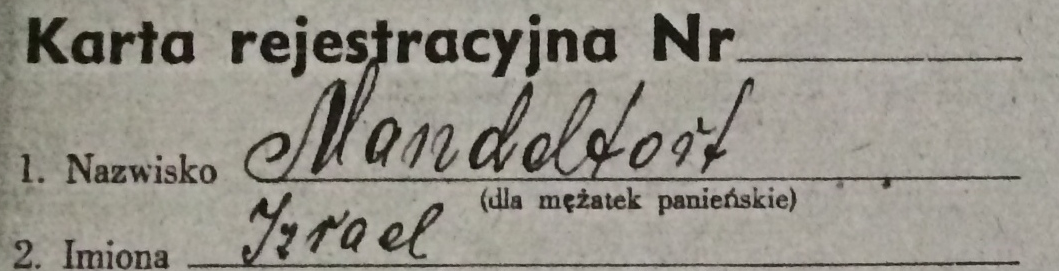
Here’s an extract from Josef’s Registration Card:
 |
| from Josef's Registration Card |
He was not Josef - he was Izrael.
So Izrael Mandeltort came back to Poland after the War, and became Josef Florkiewicz.
And we haven't finished with Laja's card yet - for further discussion see (coming soon):
Laja’s War - Laja’s other Grandmother